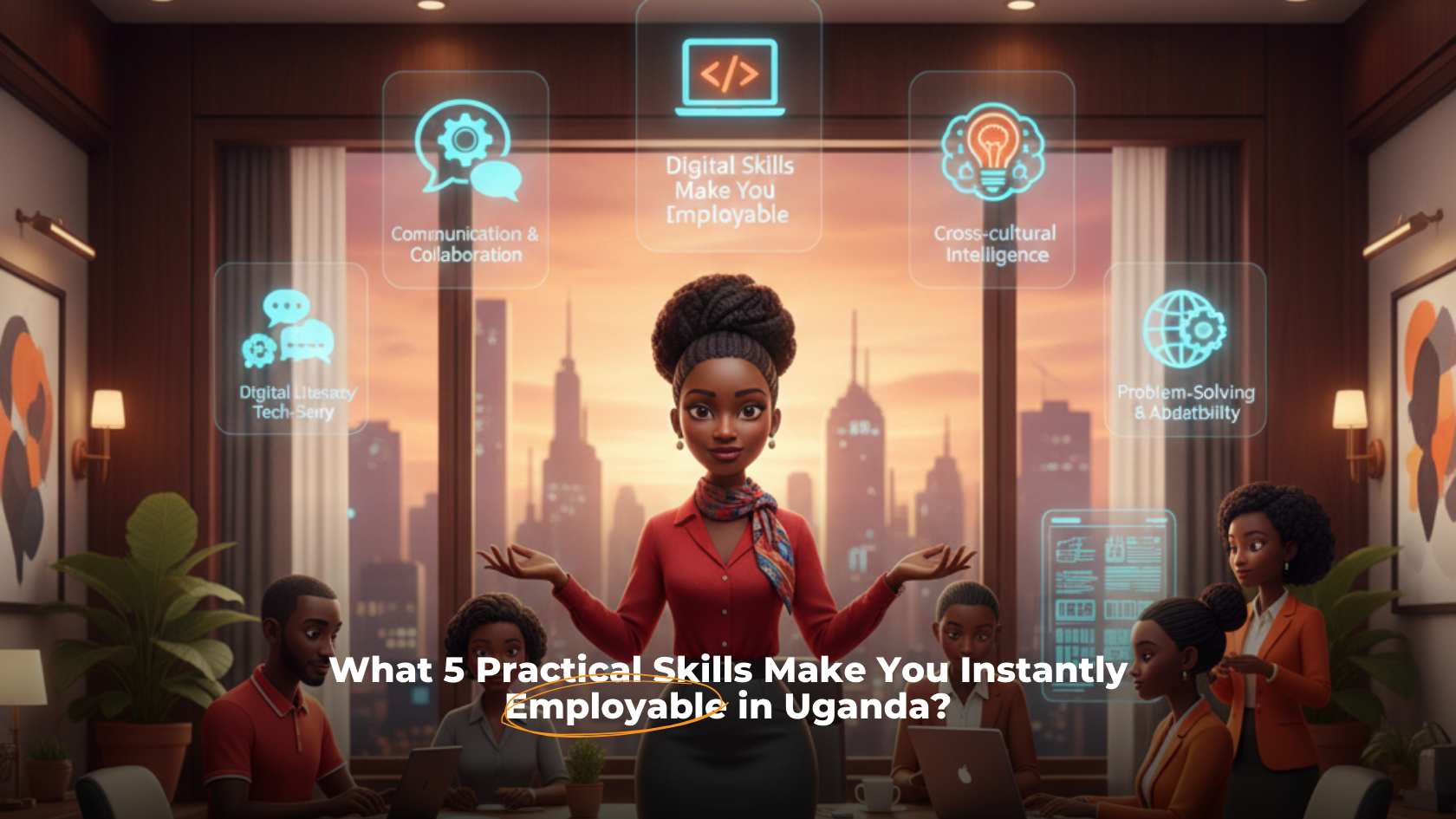
Here’s a direct answer: To become instantly employable in Uganda in 2025, focus on developing these five practical skills: digital literacy & tools, communication & teamwork, entrepreneurship mindset, data & analytics familiarity, and financial & business-literacy. These align with employer demands and major youth-employment initiatives (such as those by the Mastercard Foundation).
TL;DR:
- Only ~12.9% of Ugandan graduates secure formal employment – skills mismatch is a big cause.
- The Mastercard Foundation is targeting 4.3 million Ugandan youth by 2030 for ‘dignified work’.
- You can gain an edge by focusing on five skills employers consistently signal they value.
Table of Contents
Why these practical skills matter in Uganda’s 2025 job market
In Uganda, several facts show why up-to-date, market-relevant skills are critical:
- The youth employment challenge is large: only around 12.86% of graduates secure formal jobs.
- The labour-market analysis shows many youth are in low value informal work because of skills gaps.
- Employers in Uganda-based research highlight the importance of soft skills like creativity, teamwork, communication, adaptability.
- The Mastercard Foundation’s “Young Africa Works” programme in Uganda focuses on sectors like digital economy, agriculture, entrepreneurship thus skills aligned with those sectors are in demand.
Therefore, by aligning your skillset with what the market demands both technical/practical *and* employability or ‘soft’ skills — you significantly improve your chances of obtaining a job or launching your own venture.
Skill #1: Digital literacy and tools
What it means: Being comfortable with common digital tools (Office 365/Google Workspace, spreadsheets, basic data entry), knowing how to learn new software, and understanding how digital workflows work. As Uganda’s private-sector and MSME scene increasingly use digital tools, this is foundational.
Why it matters:
- The digital economy is one of the priority areas for youth employment in Uganda.
- Employers highlight ‘computer literacy’ and ability to apply knowledge as important employability skills.
How to build it:
- Complete short online courses in spreadsheets, basic programming (if interested), Google Analytics or similar tools.
- Volunteer for tasks in your current role or community that involve digital tools (data capture, social-media, online forms).
- Create a portfolio: e.g., a Google Sheet you built, a website you helped set up, data dashboard you made even a small one counts.
Skill #2: Communication & teamwork
What it means: Clear oral and written communication, ability to collaborate with others, respond to feedback, respect cultural and organisational norms in Uganda’s workplace. Teamwork means contributing constructively in groups, taking initiative, and adapting.
Why it matters:
- A study in Uganda found teamwork skills had a strong correlation with graduate employability.
- Employers emphasise communication, teamwork and flexibility in graduates.
How to build it:
- Join or volunteer in campus clubs, community service, group-projects to strengthen teamwork.
- Practice writing short reports, presentations or memos — and solicit feedback.
- Network with peers, mentors, join group discussions or online forums — practise listening and articulating ideas concisely.
Skill #3: Entrepreneurship mindset (problem-solving & initiative)
What it means: Whether you plan to work for someone else or start something yourself, employers and businesses value mindset traits: identifying opportunities, taking initiative, solving problems independently, adapting to change.
Why it matters:
- The youth employment strategy in Uganda emphasises youth-led enterprises and transitioning to dignified work.
- Research shows ‘creativity, innovation, entrepreneurship’ among top skills valued by employers and students alike.
How to build it:
- Identify a small problem in your community or school/workplace; propose and try a solution (even if informal).
- Enroll in micro-learning modules on entrepreneurship, business modelling, customer discovery (for example the free courses via BrighterMonday Uganda / campaign). Link: BrighterMonday Uganda.
- Reflect on failures / mistakes: keep a learning journal on what went wrong, what you would do differently this builds resilience.
Skill #4: Data & analytics familiarity
What it means: The ability to interpret data (even simple tables or charts), make decisions using basic metrics, understand business performance indicators. You don’t need to be a data scientist, but you should be comfortable with numbers and insights.
Why it matters:
- The labour-market skill gap report for Uganda shows that skill mismatches include lack of data and analytical capacity.
- Employers increasingly expect adaptability and higher-order thinking, which data literacy supports.
How to build it:
- Take free tutorials in Excel data functions, pivot tables, or Google Sheets. Practice with a dataset (e.g., local business, sales records, etc.).
- Read a local industry report (e.g., the National Planning Authority Employment & Skills Status Report 2022) and summarise key trends.
- Use data to inform a decision: e.g., track your personal budget, small-business cashflow, or measure social media engagement this builds your analytical muscle.
Skill #5: Financial & business literacy
What it means: Understanding basic business and financial concepts (e.g., revenue vs cost, profit margin, budgeting, cash-flow), and being able to apply them either in a job or for self-employment. Also includes mindset of accountability, learning financial tools and basic business planning.
Why it matters:
- The Mastercard Foundation’s skilling programme emphasises linking vocational training to entrepreneurship and enterprise start-up support.
- Studies on soft skills and employability in Uganda highlight integrity, business-mindset and financial understanding as differentiators.
How to build it:
- Learn a short accounting/budgeting module: there are free online tools or workshops in Kampala that teach MSME business basics.
- Build a simple personal budget or help a friend plan a small-venture budget to track income and costs.
- When applying for a job, demonstrate you can think about business outcomes: mention in your CV how you saved cost, improved efficiency, or helped revenue in past role this shows you speak business language.
Putting it all together: A practical 6-week plan
Here’s a suggested roadmap you can follow to build these skills in 6 weeks:
- Week 1-2: Choose one digital tool to master (e.g., Excel or Google Sheets) + practice a personal project (budget, data tracking).
- Week 3: Join or form a group (club, community initiative) to practice communication & teamwork – maybe volunteering or small project.
- Week 4: Identify a small problem (in your circle) and propose a solution – exercise your entrepreneurship mindset.
- Week 5: Obtain a dataset (or create one) and analyse it: draw a simple insight, chart, decision recommendation – build the data & analytics skill.
- Week 6: Create or review a personal/business budget, draft a mini-business plan or apply business logic to an existing initiative – build your financial & business literacy.
After week 6, update your CV/profile on platforms like BrighterMonday Uganda, write a short summary: “Strong in digital tools, teamwork, analytics & business mindset” and be ready to articulate this in job interviews or entrepreneurial settings.
Summary & Next Steps
In Uganda’s 2025 job market, having a degree is no longer sufficient on its own—the key differentiator is the *skills* you bring. By focusing on:
- Digital literacy
- Communication & teamwork
- Entrepreneurship mindset
- Data & analytics familiarity
- Financial & business literacy
You’ll align more closely with what employers and programmes (like the Mastercard Foundation’s youth-work initiatives) are seeking. Start actively building and documenting these skills, update your profile and CV, and take consistent action.
👉 If you’re a young woman between 25-35, especially as part of our #BeABossLady campaign at BrighterMonday Uganda, these are exactly the skills our free micro-learning courses aim to reinforce. Claim your space, complete the learning, and unlock your earning potential. #BeABossLady
Frequently Asked Questions
Why are soft skills so important in Uganda’s job market?
Soft skills such as teamwork, communication and adaptability help job-seekers perform in real workplaces. Research in Uganda found a significant positive relationship between these and employability.
How quickly can I build these skills?
While mastery takes time, you can make meaningful progress in 4-6 weeks by dedicating regular effort as outlined in the plan above. Document your projects for your CV.
Will these skills help me find formal employment or start a business?
Yes, these practical skills are valued both in formal jobs and self-employment/entrepreneurship. They help you show readiness, adaptability and value-creation no matter your path.