
When the National Social Security Fund (NSSF) declared a record-breaking 22.53% interest rate for the 2025/2026 financial year, the announcement dominated headlines across East Africa. Crediting a total payout pool of UGX 5.44 trillion directly to member accounts, this milestone marks the highest single-year return in the Funds history.
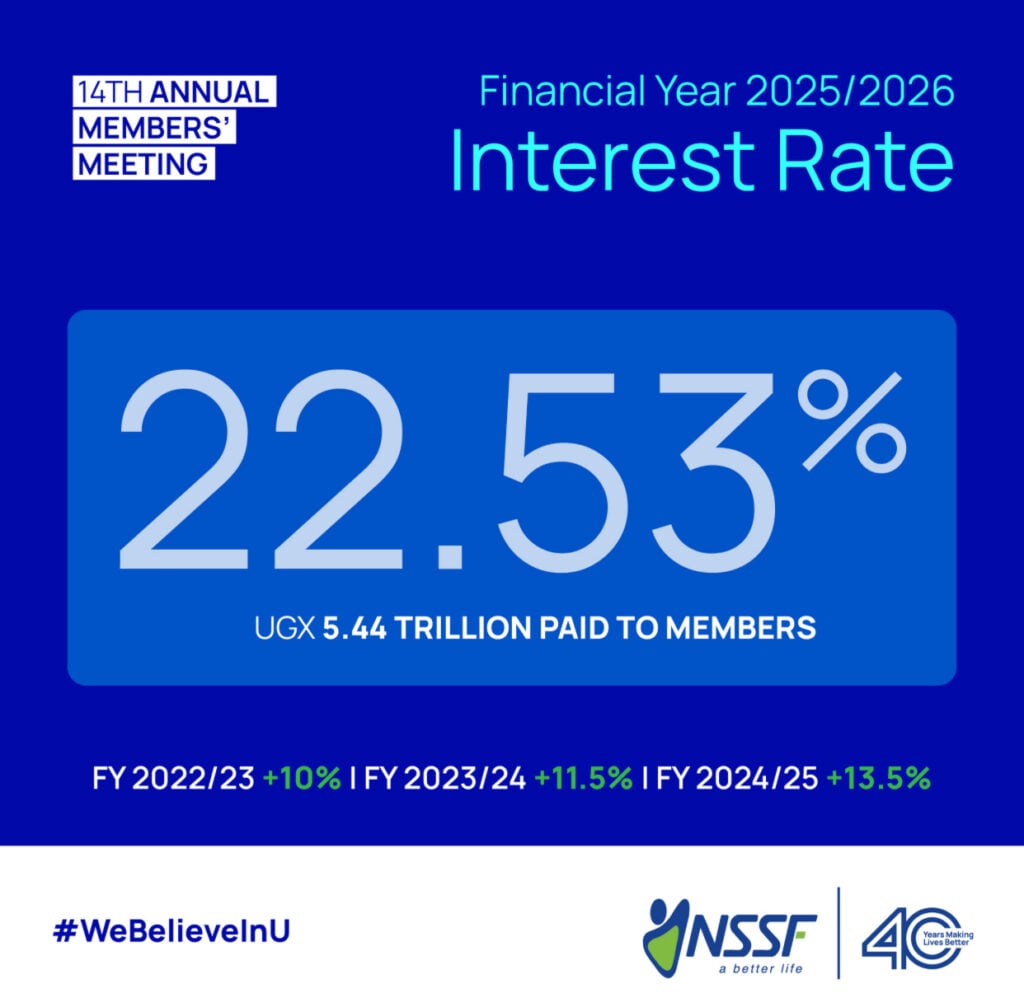
For many employees, social security feels like a distant deduction—a mandatory withholding on monthly earnings that only matters decades down the road. However, a return of this magnitude is a wake-up call for workforce economics. Whether you are an entry-level job seeker, a mid-career professional, or an HR leader, understanding this payout is crucial to leveraging your career earnings for long-term wealth.
With national inflation holding steady around 3.7%, a 22.53% interest rate delivers an extraordinary real inflation-adjusted return of roughly 18.8%. Rather than merely preserving value, employee savings in the Fund are experiencing genuine capital expansion.
To put these gains into perspective, an account maintaining an average balance of UGX 2,000,000 over the past year receives approximately UGX 450,600 added directly to its total. Workers holding a UGX 5,000,000 average balance see an injection of roughly UGX 1,126,500. For those with a UGX 10,000,000 balance, the interest payout reaches around UGX 2,253,000, while a UGX 25,000,000 balance earns over UGX 5,632,500 in added value. These exceptional returns were generated through an 85% surge in total income, propelled by strong market performance, robust yields on East African Treasury holdings, and significant dividend and fair-value gains across regional stock markets.
Reframing Retirement Planning for Early Career Professionals
A common misconception among younger professionals is that retirement planning can wait until mid-career or later. However, wealth accumulation in managed pension structures relies fundamentally on time horizon compounding. Saving even UGX 200,000 per month starting in your early twenties yields exponentially higher long-term wealth than attempting to catch up with twice that amount in your late thirties.
Beyond mandatory contributions, voluntary options like the NSSF Smartlife Flexi scheme allow professionals to expand their savings strategy beyond the standard statutory thresholds. Channeling performance bonuses, consultancy fees, or secondary revenue streams into high-yielding, institutional-grade pension structures allows individual professionals to build wealth alongside major market movements.
Strategic Implications for Employers and HR Leaders
For organizations, HR executives, and talent managers, high-performing statutory funds fundamentally change candidate expectations regarding total remuneration packages.
- Retirement Benefits as a Recruitment Differentiator: Top talent evaluates compensation beyond base salaries. Companies that highlight consistent compliance, transparent NSSF processing, and voluntary contribution match initiatives hold a distinct edge in attracting high-caliber candidates.
- Financial Wellness and Employee Retention: Financial insecurity directly correlates with workplace anxiety and lower productivity. Establishing financial literacy programs that clarify how statutory deductions build long-term personal equity fosters greater employee satisfaction and organizational loyalty.
Actionable Next Steps for Workers
A historic payout serves as an ideal checkpoint to review your career financial health:
- Verify Your Account Credit: Access the official NSSF portal or app to ensure your FY2025/2026 interest allocation has been credited accurately against your average balance.
- Audit Employer Remittances: Confirm that your monthly 5% employee deduction alongside your employer’s mandatory 10% contribution have been consistently remitted without gaps.
- Optimize Personal Allocations: Re-evaluate your budget to determine if allocating additional discretionary income into voluntary savings vehicles aligns with your mid-term and long-term career goals.